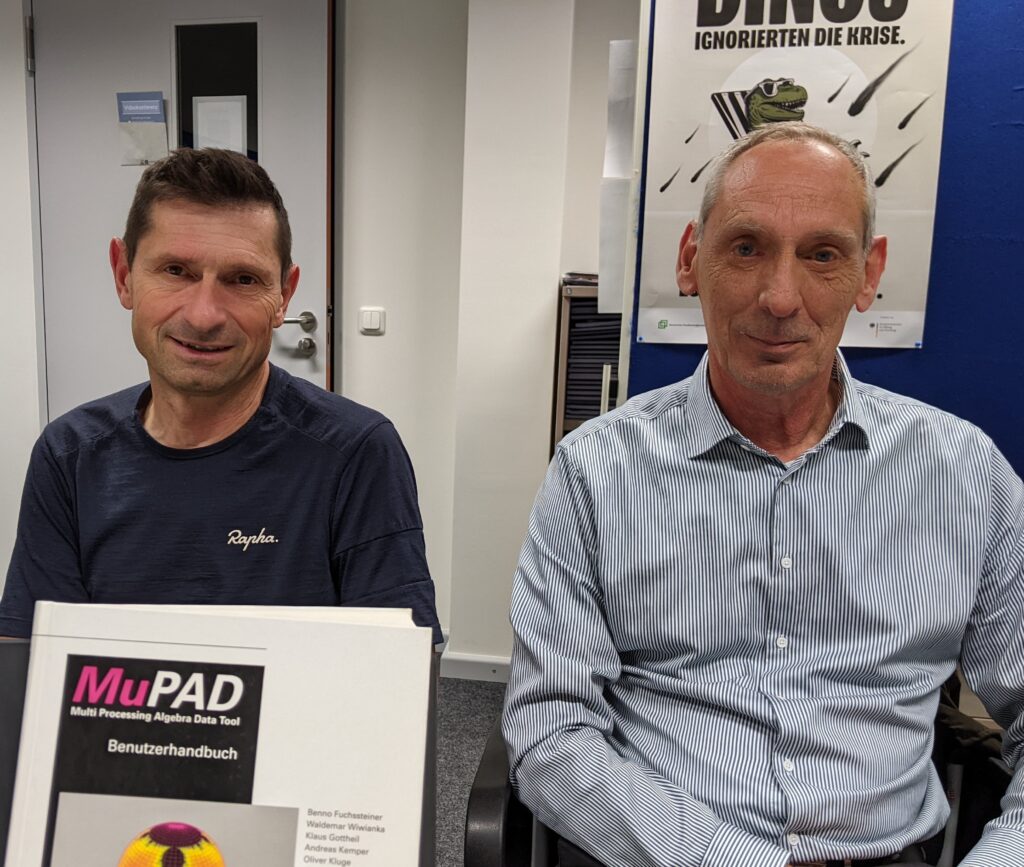
On October 13, 2026 Stefan Esselborn and Andrea Reichenberger (Deutsches Museum Munich) visited Prof. Dr. Karsten Morisse as well as Dr. Oliver Kluge at the University of Applied Sciences Osnabrück.
Karsten Morisse and Oliver Kluge count among the central figures of the early development phase of MuPAD at the University of Paderborn. Within the research group of Prof. Dr. Benno Fuchssteiner, they significantly shaped the system as developers and mathematical software architects. Their work encompassed both the conceptual implementation of theoretically-algebraic structures and the development of central software components.
Originally conceived as a research tool in an academic context, MuPAD (Multi Processing Algebra Data Tool) distinguished itself by pioneering technical features:
- Object-oriented mathematical domains: In contrast to contemporary Computer Algebra Systems, which frequently processed mathematical expressions as flat strings, MuPAD introduced object-oriented domains at the beginning of the 1990s. Mathematical structures such as rings, fields, or Lie algebras could be modeled as typed objects with inheritance characteristics.
- Parallel processing: The system was specifically designed to leverage the processing power of parallel hardware architectures for complex symbolic calculations.
During the initial academic phase, MuPAD was developed as a publicly funded research project at the University of Paderborn. Over the course of its history, initially freeware models were used. The transition to a spin-off and commercialization was marked by the founding of SciFace Software GmbH & Co. KG in 1997, as well as the gradual change of distribution and license models. Finally, it was acquired by The MathWorks in 2008. As a result, the standalone MuPAD user interface was discontinued; however, the core continues to be used as a proprietary engine in the Symbolic Math Toolbox of MATLAB.
We thank Prof. Dr. Karsten Morisse and Dr. Oliver Kluge for the fruitful conversation and valuable insights into the history of computer algebra.