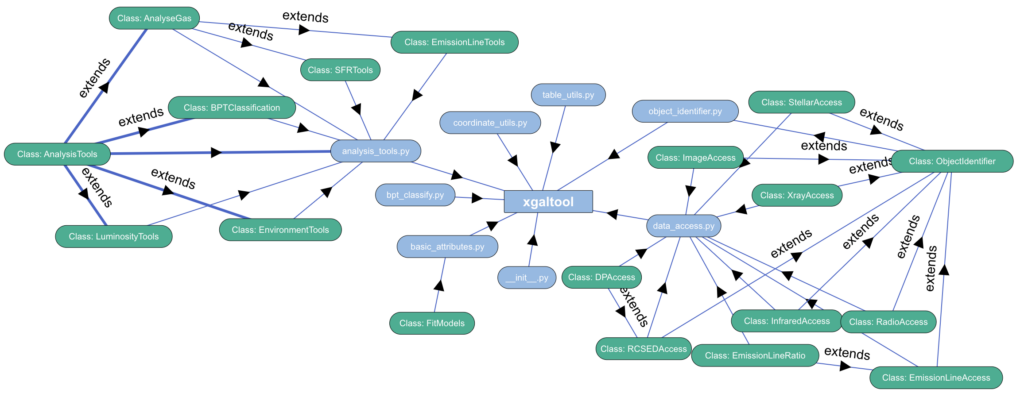
Source code is a crucial document for the study of historical software. Yet it is a special kind of written text. For example, reading code in a linear way is difficult because parts of the program code are split across external functions and classes. It is therefore hard to get an overview of how the different parts of a program interact with one another. On top of that, classes depend on other classes through the concept of inheritance. The software tool GICAT (General Isomorphic Code Analysis Tool), developed at the Computational Science Studies Lab (CSS) at RWTH Aachen University, allows code researchers to visualize dependencies in software code.
Why GICAT?
GICAT visualizes a project’s code structures, traces its development through its Git repository, and uses regular expressions to detect specific code patterns, which can then be displayed as a graph. These visualizations provide a structured way of accessing code that is often difficult to analyze with conventional software documentation.
Features of GICAT
GICAT can be applied to different code projects and research questions. Researchers create filters to represent specific elements in the source code as nodes and their relationships as edges. This enables them, for example, to track which classes depend on one another, or to identify frequent and centrally connected elements within a project. They can either use the ready-made filters available for many programming languages or create their own, which means GICAT is not tied to any specific language and allows for customized analyses.
Further information
Gabriele Gramelsberger, Daniel Wenz, and Dawid Kasprowicz provide an example of using GICAT in their article “Understanding and Analysing Science’s Algorithmic Regimes: A Primer in Computational Science Code Studies”. They show how scientific concepts and programming practices can be studied together. The analysis makes clear how mathematical models are implemented in code and how research objects and terms may change in the process. In this way, program code becomes an important source for understanding the digital transformation of scientific work.
The potential of GICAT for scientific code analysis is further explored in “Code and Concepts: Exploring Scientific Code with GICAT” by Gabriele Gramelsberger et al. A detailed description of the tool is also available on the CSS Lab website. The Downloads section includes executable versions for Linux, macOS, and Windows. The source code is available on GitHub, and the tool is licensed under EUPL 1.2. The predefined filters can also be found on GitHub.