A computer algebra system differs fundamentally from conventional numerical software – and the proverbial pocket calculator – in that it operates on exact symbolic expressions such as variables, functions, and polynomials rather than calculating approximate values using floating-point arithmetic. While Gaussian elimination had long provided a standard method for solving systems of linear equations, a constructive approach to solving and simplifying nonlinear multivariate polynomial equations remained elusive for many years.
As a pioneer of symbolic computation, Bruno Buchberger closed this fundamental gap. His theory of Gröbner bases – named after his doctoral supervisor at Innsbruck, Wolfgang Gröbner – and the Buchberger algorithm, formulated in 1965, now form the algorithmic foundation of modern computer algebra systems (such as Mathematica, Maple oder Singular). Beyond pure mathematics, the method has an enormous practical impact: from the verification of error-free microchips and modern cryptography to geometric path planning in robotics and the modelling of biochemical signalling and reaction networks, Gröbner bases are among the key technologies of industrial and scientific computing.
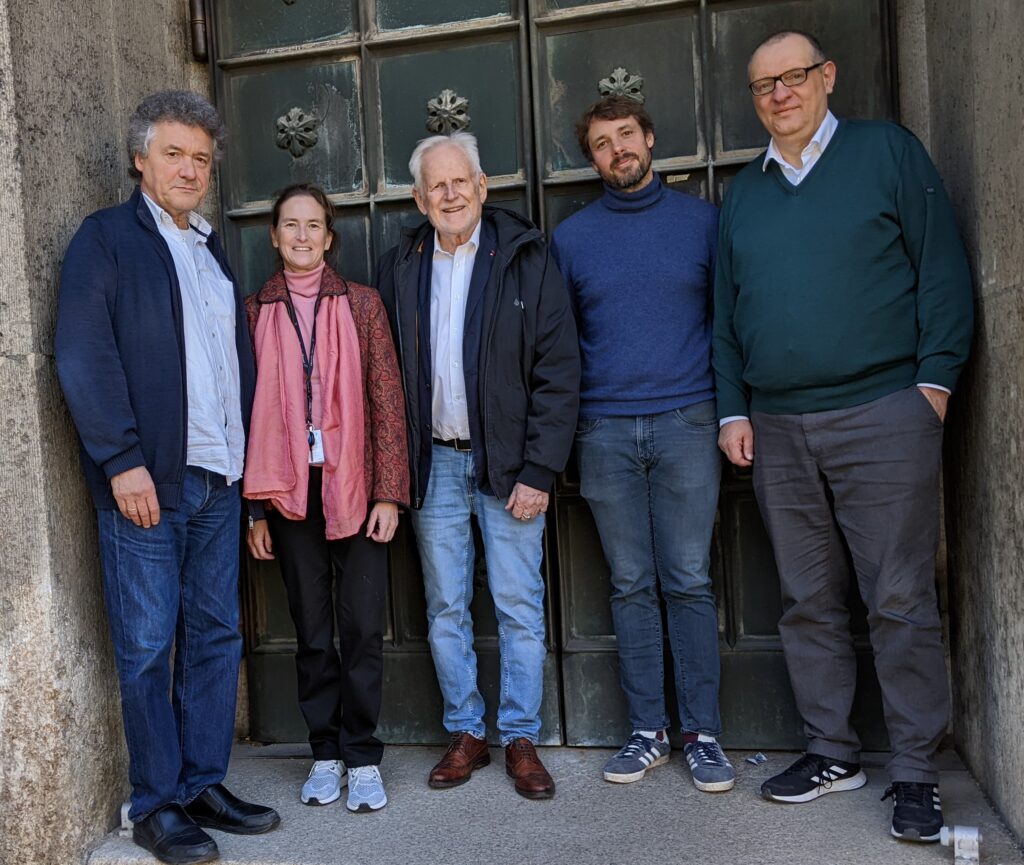
Copyright: Andrea Reichenberger
On 26 and 27 October 2026, Stefan Esselborn, Ulf Hashagen, Andrea Reichenberger, and Rudolf Seising (Research Institute of the Deutsches Museum, Munich) conducted an extensive oral history interview with Prof. Dr. Bruno Buchberger (Johannes Kepler University Linz).
A central focus of the interview was the technical and practical challenges of software development and programming, ranging from the hardware-oriented beginnings of computer arithmetic on the Zuse Z23 to modern automated theorem-proving systems in the age of AI. From a software-historical perspective, the international research project Theorema, initiated by Buchberger at RISC (Research Institute for Symbolic Computation at JKU Linz) in the mid-1990s, represents a pioneering development. The system combines exact algorithmic computation with formal mathematical logic, enabling researchers to incrementally construct and explore complete mathematical theories.
Beyond software architecture itself, Bruno Buchberger has had a lasting influence on the European landscape of computer science and innovation. Beginning with the founding of the RISC research institute at Schloss Hagenberg, he went on to establish Softwarepark Hagenberg near Linz, an internationally renowned technology and start-up centre that brings together cutting-edge university research, academic education, and the software industry in a single location.
We extend our heartfelt thanks to Prof. Dr. Bruno Buchberger for two inspiring days, the open and engaging discussions, and the valuable insights into six decades of programming, system architecture, and mathematical theory development.