Alongside universities and research institutions, private companies sometimes played a central role not only in the use but also in the development of scientific and technical software. This is illustrated by the life and career of Prof. Dipl.-Ing. Peter Groth, whom Stefan Esselborn (Deutsches Museum, Munich) had the opportunity to visit in Pfullingen (near Reutlingen) on November 2, 2026, for an EWS interview.
Groth joined Daimler-Benz AG in 1963, working in the research group led by Alfred Zimmer, who passed away in 2011. Together with Zimmer, he was responsible for developing ESEM (Elasto-Statik-Element-Methode), the first general-purpose structural analysis program developed in industry. ESEM – written in FORTRAN II for the IBM System/360 – was based on the lattice framework method proposed by Alexander Hrennikoff (1940), in which the structure to be analyzed was idealized as an equivalent framework of bar elements. The program calculated forces in individual elements and deformations under load, allowing it to be used to solve stiffness problems, perform stress analyses, and optimize complex structures
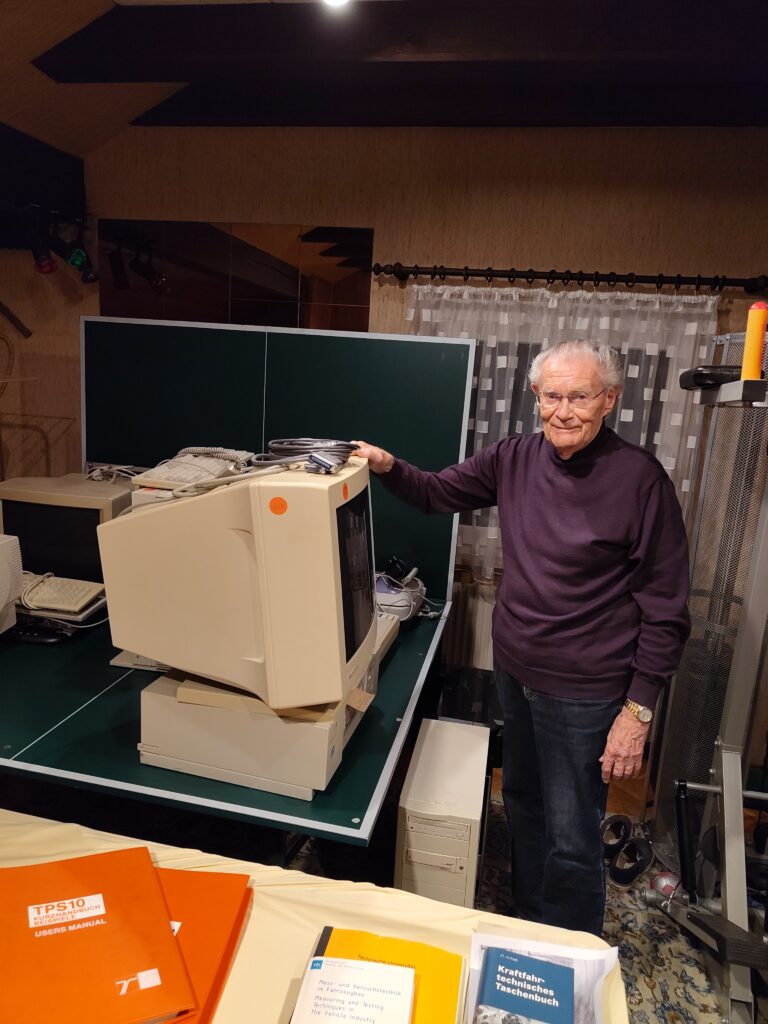
As Groth recalled, ESEM made its first major appearance within the company during the development of the W115, the Mercedes-Benz 200 series introduced in 1968 (also known as the "Strich-Acht"). ESEM calculations made it possible to identify and correct a weak point in the front floor structure, convincing the initially skeptical management board of the advantages of the new approach. In 1969, Groth carried out FEM calculations for the C111 Wankel-engined sports car prototype. This pioneering development of a passenger car with computer assistance – the first of its kind worldwide – was documented by Daimler-Benz and IBM in a promotional film entitled "Das Auto, das aus dem Computer kam" ("The Car That Came from the Computer"), which was shown around the world. In 1970, Zimmer and Groth published "Elementmethode der Elastostatik", the first German-language textbook on the finite element method (FEM).
n 1971, Groth became self-employed as one of three partners in T-Programm GmbH and further developed ESEM into the TPS10 software system. It was used by numerous German and international automobile manufacturers and suppliers, in the construction industry, and at universities and other higher education institutions. For decades, it remained one of the most widely used FEM development tools worldwide. Since 2019, it has been available free of charge for research and teaching under the name TPx_HPC.
We would like to thank Prof. Groth for the extensive interview, the fascinating insights into the history of FEM, and the wealth of historical source material he generously made available.